Water fertilizer: There are many types of water fertilizers for aquatic plants, but you should avoid overdosing, which can lead to algae growth and metal toxicity. Some special water fertilizers work much better and include just the right amount of essential nutrients, without too much or too little of any particular element.
Characteristics of the plant
Leaf: The leaves of terrestrial plants can absorb nutrients directly by spraying fertilizer on the leaves and branches. But for aquatic plants, it’s different; the leaves of aquatic plants do not absorb nutrients directly but only serve the purpose of photosynthesis and osmosis of ions. Underwater leaves are very thin, and if they absorb nutrients, they will also rot, as you all know how hot fertilizers can be; this is basic knowledge.
Roots: This is the main part that absorbs nutrients for the plant. All nutrients are absorbed directly by the roots and converted to nourish the stem and leaves. Therefore, if bucephalandra or aroids do not have roots, you will see the plants stagnate for a long time; only when they develop roots do they start to grow again, or bucephalandra and aroid stems without roots for a long time will age and become senescent due to lack of supplemental nutrients.
Understanding these two characteristics will make it easier for us to dose water fertilizer.
Water fertilizer
Trace elements: There are many trace elements in the substrate; most substrate types have a base, so if you are playing with bucephalandra or nana, it seems indispensable.
In the past, when you played with cuttings, did you ever have to dose water fertilizer? The cuttings had such a strong pull that the substrate took a whole year to start showing signs of color loss, so why do we need to dose trace elements and iron for bucephalandra and aroids when they are weak nutrient absorbers?
Macronutrients: This is what is often lacking in aquariums because plants need macronutrients. When plants absorb enough macronutrients, they can start to absorb secondary and trace elements. If the plants do not absorb enough macronutrients and we dose trace elements, the plants will not be able to utilize them, which will gradually lead to toxicity.

You can learn about types of water fertilizers here
Observing the plant
First, we need to look at the roots because they are the main absorption part; everything we dose into the tank’s effectiveness depends on this root system.
If the plant has no roots, stop dosing all types of water fertilizers. At this point, we must dose root stimulants or aerate the plants to wake them up. Only when roots start to develop can we begin to dose macronutrients, but do it gradually because the roots are still few and weak and cannot absorb much (ignore trace elements; you don’t need to worry about them because there are plenty in the substrate).
You can aerate 24/7 to help the microbial system process nutrients for the plants to absorb more easily, and every day dose 1ml of Excel for every 100 liters of water to convert heavy metals that the plants find hard to absorb into forms that are easier for the plants to take in. This helps the plants absorb trace elements better.
Note: For tanks that dose a lot of trace and macronutrients, you will need to drain 80-100% of the water the next day after dosing a large amount. You may notice some people draining the tank completely once.
The reason is that after one day, the water fertilizer will start to seep into the substrate, which will then release nutrients back for the plants to absorb. Therefore, any excess in the water can be toxic and dangerous for the plants, so it needs to be removed. That is a trick when dosing a lot of water fertilizer.
For tanks with less water change, the trace elements in the substrate will be sufficient for the plants, or occasionally you can dose a little trace element in case of frequent water changes where the trace elements cannot be released quickly enough, or if using inert substrate, then you need to supplement a little.
But one principle is that the plants must be healthy, must have enough macronutrients, and strong roots before thinking about trace elements. If these factors are not sufficient, then trace elements will be useless.
Understanding the roles of leaves and roots makes it much easier to use water fertilizers correctly, right?

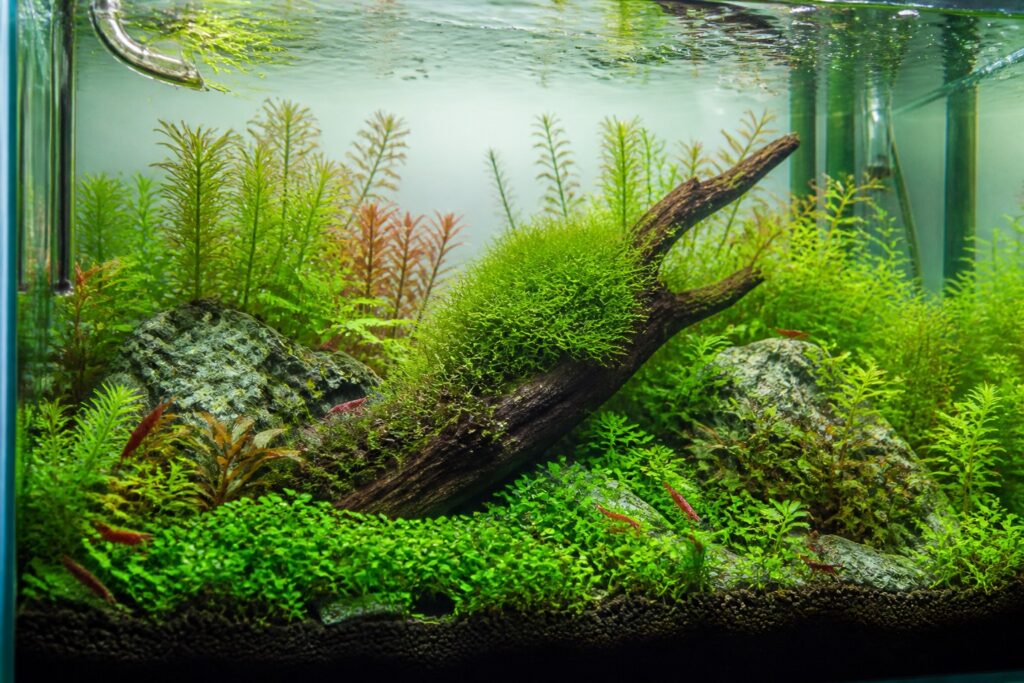
Above is a picture of my tank with 90% bucephalandra after 20 days of growth. Just focus on health first, and it will automatically look beautiful. Because having just a stem with 1-2 leaves looks very dull.
I hope after this article, you can better understand how to use different types of water fertilizers effectively.
Instructions for Mixing Seachem NPK
Nitrogen: 500ml
Phosphorus: 250ml
Potassium: 250ml
Mix them all together.
Dosing: 1ml / 100 liters of tank water daily (because Seachem is twice as concentrated as JBL, only use 1ml).
No need to top up when changing water, okay everyone?
Note: Remember to aerate 24/7 to make the metabolic process in the plants more effective and the microbial system healthier.
Fertilizer Dosing Formula for a 100-Liter Tank
• 2ml macronutrients daily
• 1ml Excel daily
• 1ml Flourish weekly (since the substrate is inert, you must dose 1ml of comprehensive trace elements weekly; if you have a substrate, you don’t need to dose) start supplementing trace elements in the third month.
How to Know if the Microbial System is Healthy
You can look at the oxygen aeration in the tank:
When the microbial system is healthy, the water will not produce bubbles when aerating. Anyone who has been keeping shrimp for a long time will know this when using bio aeration.
If the water surface has many bubbles, even if the water is clear, it does not necessarily mean that the microbial system is healthy.
Note: This is basic knowledge, not everything. It only helps you understand when to and when not to. As for the color development of the plants, it also depends on the type of substrate, type of water fertilizer, tank conditions, etc., and everyone has different ways of playing, so it will yield different colors.
trungnguyenanh.1299@gmail.com